Handheld Dynamometer in Physiotherapy: What It Is, How It Works and When to Use It
A handheld dynamometer (HHD), also written “hand held dynamometer”, is a portable device that measures how much force a muscle produces during an isometric test. It gives a number in kgf or newtons instead of a 0 to 5 manual muscle test grade, so you can compare the left and right sides and track change from one session to the next.
Key points
- A handheld dynamometer records force in kgf or newtons. Manual muscle testing records a 0 to 5 grade.
- Comparing the injured and uninjured sides gives a limb symmetry index (LSI). Many return-to-sport protocols use 90% as one criterion.
- LSI can overstate recovery if the uninjured limb has also lost strength, so record baselines early.
- Ask any supplier for a calibration certificate that names the laboratory, certificate number and date.
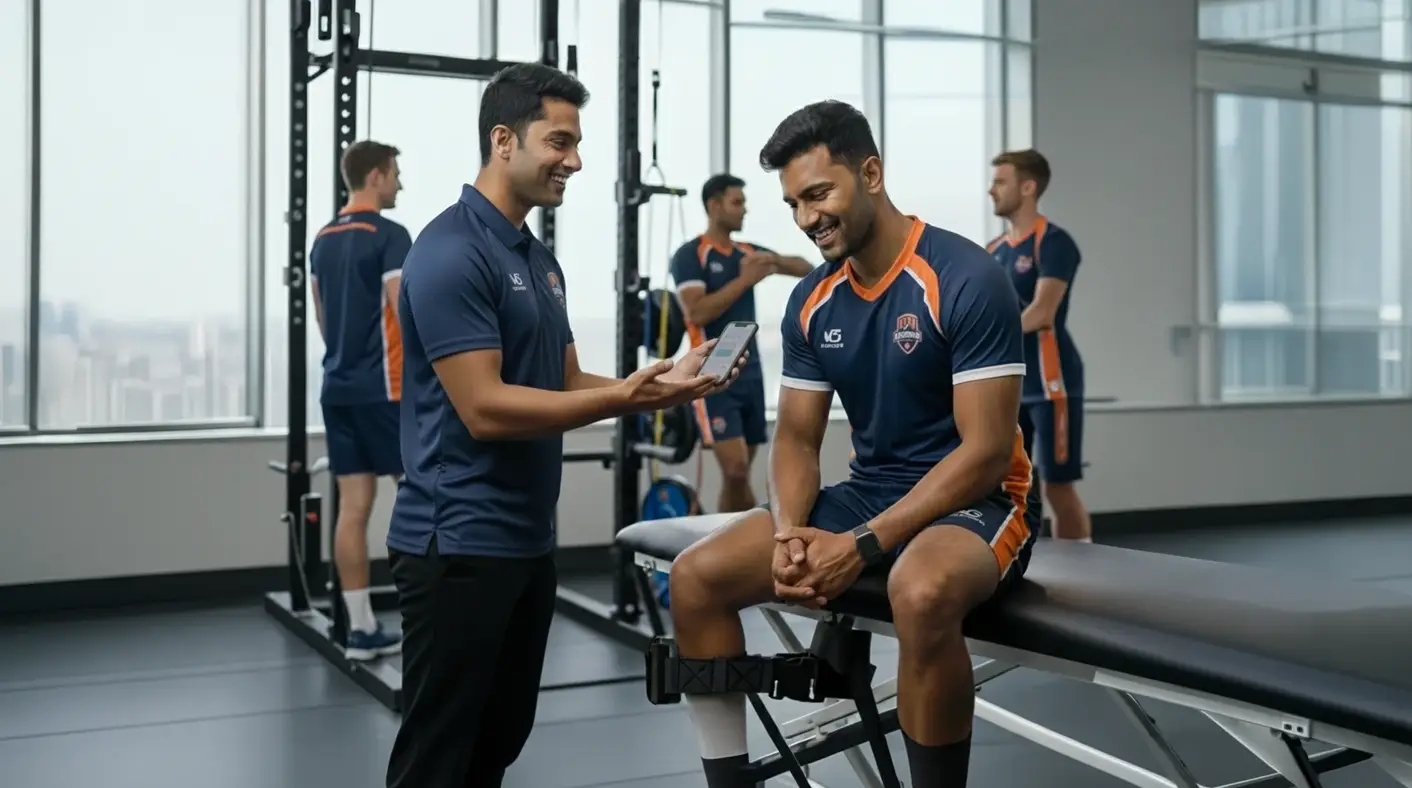
What a handheld dynamometer is and how it works
A handheld dynamometer measures peak isometric force: how hard a muscle can push against a fixed resistance while the joint stays still. A load cell inside the device records the force in kgf or newtons. A connected app can save it, compare it with the other limb and chart it across visits.
The clinician holds the device against the patient’s limb, or fixes it with a strap. The patient pushes as hard as they can. The reading appears in seconds.
That answers the question every rehabilitation plan depends on: how much force can this muscle produce today, compared with the other side and with last week?
Handheld vs manual muscle testing vs isokinetic
Manual muscle testing is the quickest check, but it records only a 0 to 5 grade. A handheld dynamometer adds a measured force at the bedside. An isokinetic machine measures torque through a movement and suits laboratories, but it needs a fixed room and a much larger budget.
The limits of manual grading are well known. The result depends on how hard the examiner can resist and how they judge the effort. A Grade 5 covers a wide range of real strength, so a patient can improve without the grade moving. Two examiners can also grade the same patient differently.
| Factor | Manual muscle test | Handheld dynamometer | Isokinetic dynamometer |
|---|---|---|---|
| What you record | A 0 to 5 grade | Force in kgf or newtons | Torque, power and work through a movement |
| Equipment and space | None | A device the size of a hand; works at the bedside | A large, fixed machine in a dedicated room |
| Cost | None | Moderate | Much higher; ask suppliers for quotes |
| Repeatability | Depends on the examiner | Good when position and strap use are standardised | High under controlled lab conditions |
| Reporting | Written notes | App report with side-to-side comparison and progress | Software reports |
| Suits | Screening and quick checks | Every-visit testing and return-to-sport decisions in a clinic | Research and high-performance labs |
Five clinical uses
Handheld dynamometry fits any case where you need to compare sides or track strength over time: return to sport, recovery after surgery, muscle imbalance, neurological rehabilitation and everyday musculoskeletal care. Each use rests on one step, a repeatable force reading you can compare with the other limb or the last visit.
Sports rehabilitation and return to play
Return-to-sport decisions rely on comparing the injured limb with the uninjured one. Test quadriceps, hamstrings and hip muscles on both sides in a few minutes and record the difference. Read our guide to criteria-based ACL rehabilitation and return to play.
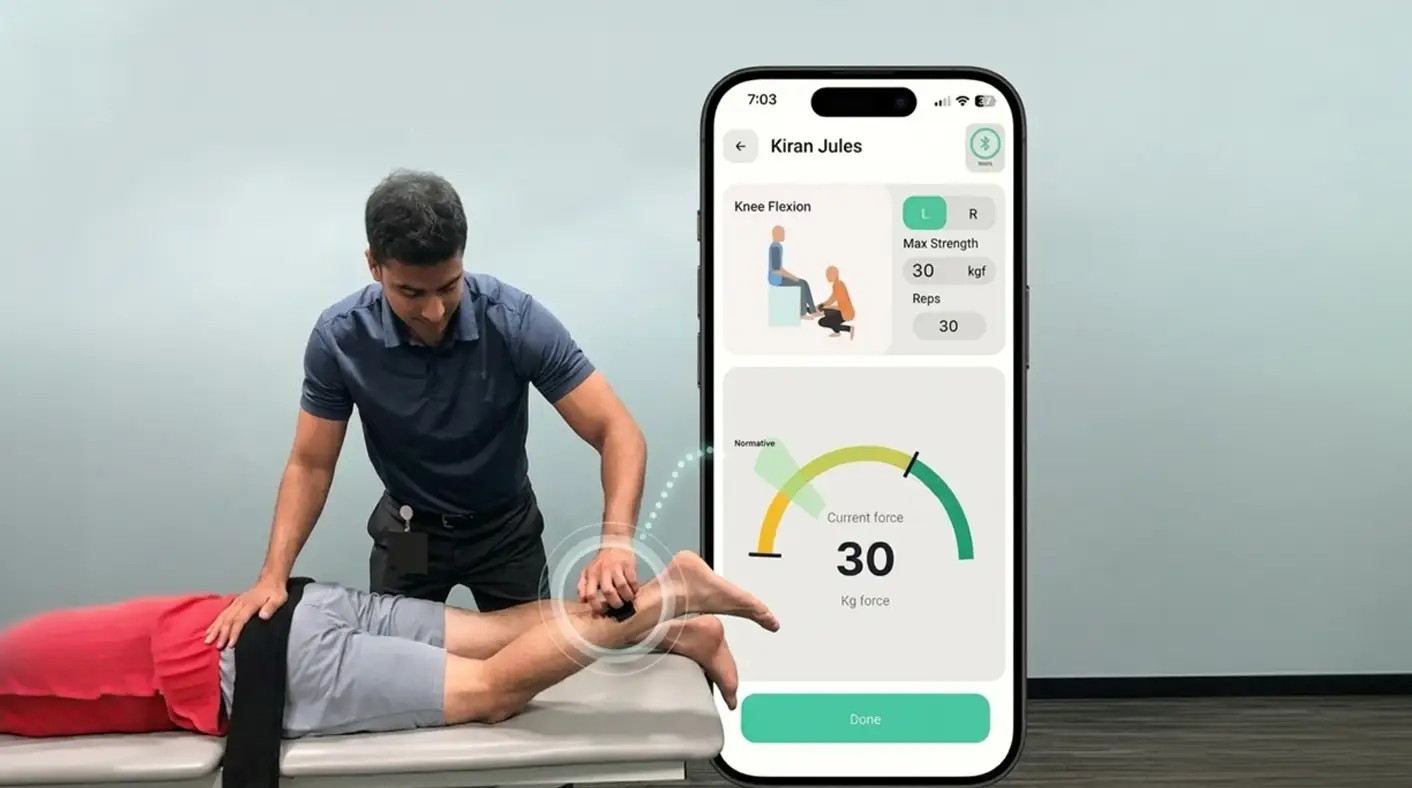
After surgery: ACL, knee replacement, rotator cuff
Many protocols advance a patient when strength reaches a target. Measuring force each week replaces guessing with a trend you can show the patient and the surgeon. For shoulders, see our guide to criteria-based rotator cuff rehabilitation.
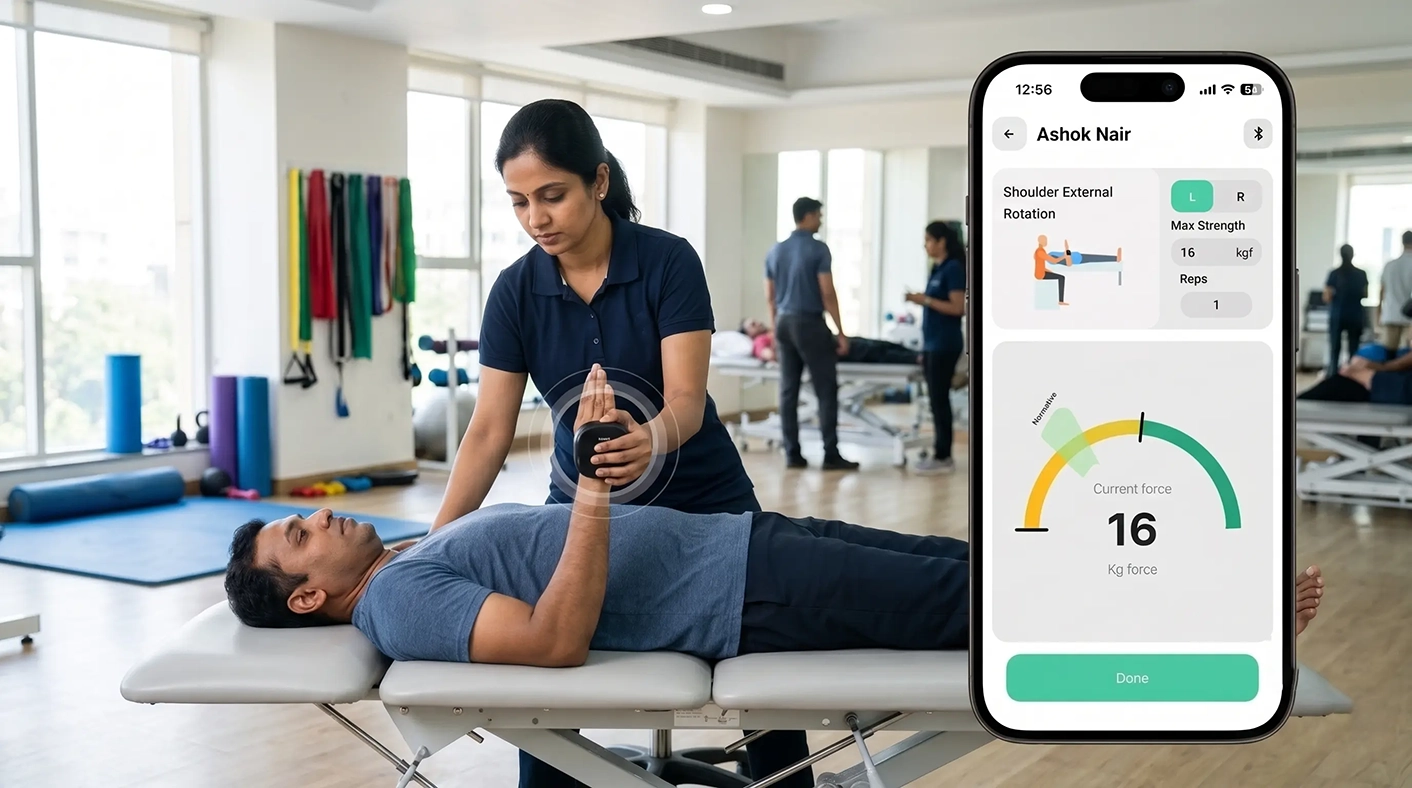
Muscle imbalance
A weaker side is easy to suspect and hard to size by hand. A reading of 30 kgf on one side and 40 kgf on the other (an example) gives you a deficit to treat and a target to retest against.
Neurological rehabilitation
For patients recovering from stroke or other neurological conditions, a force reading can show small changes that a grade does not. Use the same position and the same device each time.
General musculoskeletal outpatients
Shoulder pain, tendinopathy, patellofemoral pain and low back pain often involve weakness. Test the key muscle groups at the first visit and again at review. You get a measured picture of what changed.
What the limb symmetry index tells you
The limb symmetry index (LSI) compares the injured side with the uninjured side as a percentage. Many return-to-sport protocols use 90% as one criterion. It is a useful screen and not a verdict, because the uninjured limb may have lost strength too.
LSI = (injured side force ÷ uninjured side force) × 100
The research supports using symmetry in return-to-sport decisions, and it also shows the limits of the number.
| Study | Finding |
|---|---|
| Consensus on a successful ACL outcome (Delaware-Oslo cohort)4 | Experts agreed that quadriceps and hamstring strength above 90% of the uninvolved limb is one of the measures of a successful outcome. |
| Grindem et al., 20165 | In 2 years of follow-up, 38.2% of patients who failed the return-to-sport criteria (below 90 on any test) had a knee reinjury, against 5.6% of those who passed. That pass-fail difference was not statistically significant (p = 0.075), but more symmetrical quadriceps strength before return significantly reduced the reinjury rate. |
| Wellsandt et al., 20176 | At six months, 57.1% of patients reached 90% LSI for quadriceps strength and all hop tests. Only 28.6% reached 90% when compared with their own pre-injury levels. LSI can overestimate recovery when the uninjured limb has weakened. |
| Return-to-sport criteria in young athletes, 20237 | In skeletally mature adolescent and young adult athletes, a 90% threshold did not identify those at high risk of a second ACL injury. |
The practical point: use LSI alongside hop tests, movement quality and clinical judgement. If you can, measure strength before injury or early in rehabilitation, so you have a personal baseline and not only the other leg.
How a test is run
A good strength test follows the same steps every time: position, place, instruct, repeat, record, compare. Consistency matters more than any single step. Keep the position, strap and instruction identical at every visit, so a change in the number reflects a change in the patient.
- Put the patient in the protocol position for the muscle you are testing, and explain the movement.
- Place the device at the agreed point on the limb. Use the strap or fixture where the protocol calls for it.
- Give the same instruction every time, for example “push as hard as you can against the device and hold”.
- Run a practice effort, then repeat trials with rest between them.
- Record the best and the average result, and note any pain.
- Test the other side the same way and compare.
What to look for when buying a handheld dynamometer in India
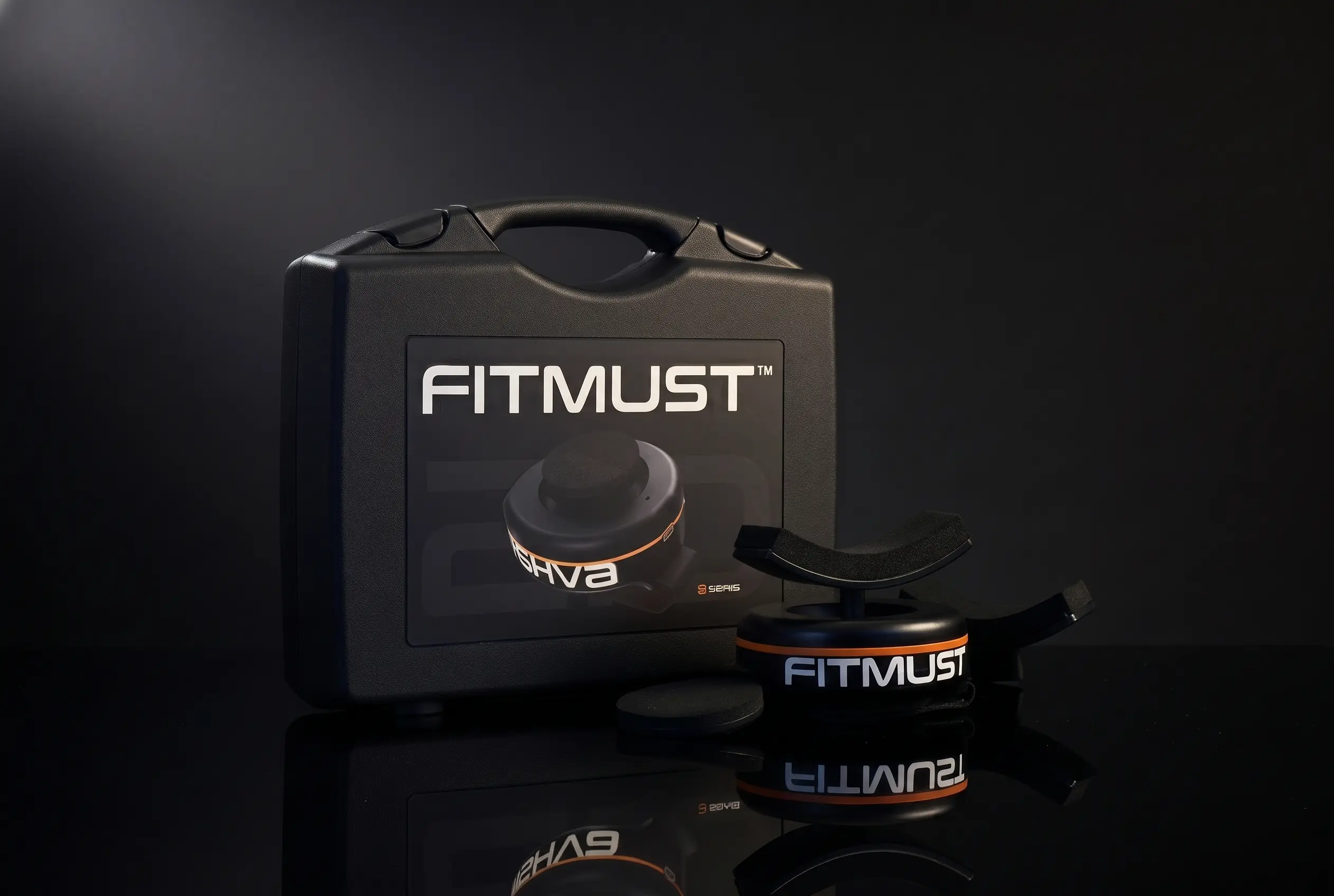
When you compare handheld dynamometers, ask for proof of accuracy, the force range, the test protocols, a sample report, published evidence on that exact device and local service. A brochure figure is not evidence. A calibration certificate that names the laboratory, certificate number and date is.
| Look at | Ask the supplier for |
|---|---|
| Accuracy proof | A calibration certificate naming the laboratory, certificate number and date. NABL accredits testing and calibration laboratories, so ask which accredited lab did the work and what it checked. |
| Force range | The maximum force the device reads, and whether it covers the large muscles you test, such as quadriceps and hip abductors. |
| Protocols | The list of muscle groups and test positions the app guides you through. |
| App and reports | A sample report. Check that it shows left and right sides, peak force, progress over time and an easy way to share it with a patient. |
| Evidence | Published reliability or validity studies on that exact device, not only on handheld dynamometry in general. |
| Build and support | The warranty, who services the device in India, and how fast they replace one. |
What the research says
Studies of handheld dynamometry generally report agreement with isokinetic testing and acceptable reliability, but results depend on the device, the muscle and the technique. A strap improves agreement between testers. Check the evidence for the exact device you plan to buy.
A systematic review comparing handheld with isokinetic testing found generally positive agreement1. A study of lower-limb strength examined both reliability and validity2. For hip and knee tests, fixing the device with an external belt made results more consistent between testers3 Read the paper.
Reliability is usually reported as an intraclass correlation coefficient (ICC). A common guide treats values from 0.75 to 0.90 as good and above 0.90 as excellent8.
Watch a test. A short video of a Fitmust test shows the position and strap better than text.
What a report looks like
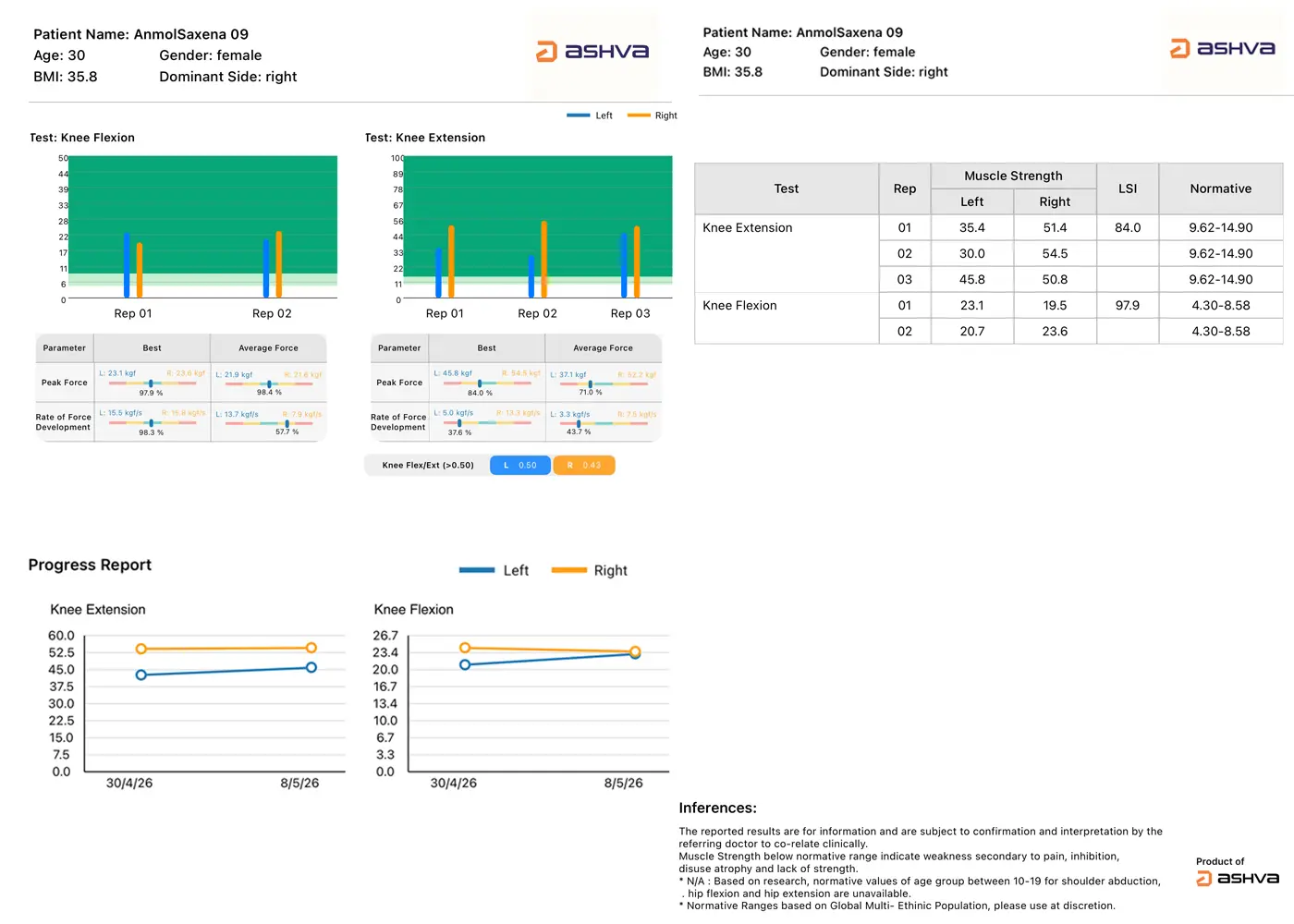
After each test, the app builds a report you can give to the patient or send to a referrer. The sample shows left and right peak force, rate of force development, the left/right difference and progress between two test dates.
To hear from clinicians who use it, read the stories from physiotherapists.
Frequently asked questions about handheld dynamometers
What is a handheld dynamometer used for in physiotherapy?
It measures isometric muscle force objectively. Clinics use it to compare the left and right sides, to check recovery after injury or surgery, and to track strength from one session to the next.
What is the difference between a handheld dynamometer and manual muscle testing?
Manual testing is graded 0 to 5 by the examiner’s judgement. A dynamometer records force as a number, which makes repeat tests and side-to-side comparison easier. Results still depend on good positioning and a consistent technique.
How accurate is a handheld dynamometer compared with isokinetic dynamometry?
A systematic review found generally positive agreement between handheld and isokinetic measurements1. Accuracy of a particular device depends on its calibration, so ask for the certificate. See what the research says.
Is handheld dynamometry reliable for clinical use?
It can be, when the test position, strap use and instructions are standardised. Reliability varies by device, muscle and technique, and a strap improves agreement between testers3.
How do you use a handheld dynamometer?
Position the patient, place the device or strap, give a standard instruction, run repeat trials, record the best and average, then test the other side and compare. The app builds a report you can share. See the six steps and a sample report.
What muscles can be tested with a handheld dynamometer?
Fitmust covers the main muscle groups of the wrist, elbow, shoulder, hip, knee and ankle. The Ashva X app guides the test position for each. Match this to the current product page.
What is a NABL-certified dynamometer?
NABL accredits testing and calibration laboratories. A device described as NABL-certified normally means an accredited laboratory checked its measurements. Ask the supplier for the certificate that names the laboratory, the certificate number and the date. For Fitmust, the stated accuracy is ±2%, checked by {{LAB_NAME}}, certificate {{CERT_NO}}, {{CERT_DATE}}.
Which is the best handheld dynamometer for physiotherapy clinics in India?
The best one gives you checkable accuracy, the force range and protocols you need, a clear report, published evidence on that exact device and local service. Use the buyer’s checklist to compare options, or book a demo and test Fitmust against the others.
Is a limb symmetry index of 90% enough to return to sport?
No single number is enough. Many protocols use 90% as one criterion alongside hop tests, movement quality and clinical judgement. Studies also show that LSI can overstate recovery when the uninjured limb has weakened, so a baseline from before injury or early in rehabilitation helps.
How much does a handheld dynamometer cost in India?
Price depends on the device and what comes with it: app, fixtures, calibration certificate, warranty and support. Message us on WhatsApp for a current quote.
Replace manual grades with measured strength data
Book a 30-minute live demo, or message us on WhatsApp with questions about test protocols, reports and pricing.
References
- Stark T, Walker B, Phillips JK, Fejer R, Beck R. Hand-held dynamometry correlation with the gold standard isokinetic dynamometry: a systematic review. PM&R. 2011.
- Mentiplay BF, Perraton LG, Bower KJ, et al. Assessment of lower limb muscle strength and power using hand-held and fixed dynamometry: a reliability and validity study. PLoS ONE. 2015.
- Thorborg K, Bandholm T, Hölmich P. Hip- and knee-strength assessments using a hand-held dynamometer with external belt-fixation are inter-tester reliable. Knee Surgery, Sports Traumatology, Arthroscopy. 2013.
- Consensus criteria for defining “successful outcome” after ACL injury and reconstruction: a Delaware-Oslo ACL cohort investigation. Br J Sports Med. 2015;49(5):335-342. PubMed.
- Grindem H, Snyder-Mackler L, Moksnes H, Engebretsen L, Risberg MA. Simple decision rules can reduce reinjury risk by 84% after ACL reconstruction: the Delaware-Oslo ACL cohort study. Br J Sports Med. 2016;50(13):804-808. PubMed Central.
- Wellsandt E, Failla MJ, Snyder-Mackler L. Limb symmetry indexes can overestimate knee function after anterior cruciate ligament injury. J Orthop Sports Phys Ther. 2017;47(5):334-338. PubMed.
- Paterno MV, Rauh MJ, Thomas S, Hewett TE, Schmitt LC. Return-to-Sport Criteria After Anterior Cruciate Ligament Reconstruction Fail to Identify the Risk of Second Anterior Cruciate Ligament Injury. Journal of Athletic Training. 2022 Sep Journal of Athletic Training.
- Koo TK, Li MY. A guideline of selecting and reporting intraclass correlation coefficients for reliability research. J Chiropr Med. 2016. journal chiropractic medicine
Content prepared by Team Ashva This guide is educational and does not replace clinical judgement.

