- Blog
- 2188
- 0
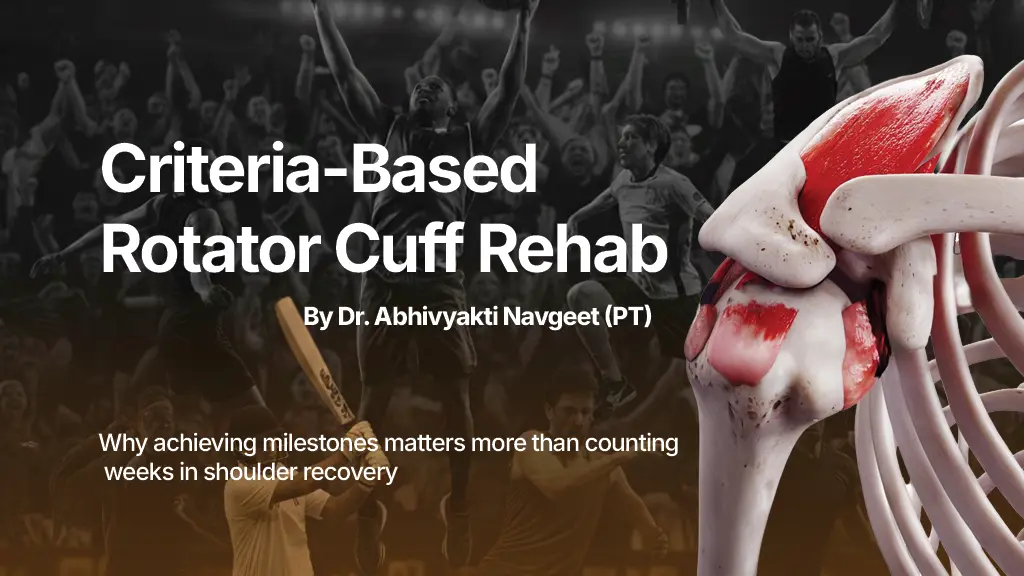
Rotator cuff rehabilitation has traditionally followed time-based protocols, progressing patients through predefined phases based on weeks post-injury or surgery. However, tendon healing and neuromuscular recovery do not respond to time alone—they respond to load.
A criteria-based rehabilitation approach prioritizes measurable clinical milestones to guide progression safely and effectively, particularly in athletic and high-demand populations.
This article outlines a phase-wise, criteria-driven framework for rotator cuff rehabilitation, as explained by Dr. Abhivyakti Navgeet (PT).
Why a Criteria-Based Approach Matters
The rotator cuff functions as a dynamic stabilizer, responsible for centering the humeral head during movement. Its role is not maximal power generation, but precision, reflex stabilization, and load control.
Key principles of criteria-based rotator cuff rehabilitation include:
- Progression based on movement quality and load tolerance
- Respect for tendon healing biology
- Assessment of function across multiple planes
- Objective measurement of strength and symmetry
Phase I: Protection and Symptom Control
Clinical Objectives
- Pain reduction
- Protection of the healing tendon
- Restoration of passive range of motion
- Prevention of distal joint stiffness
Early rehabilitation focuses on controlling pain and inflammation while maintaining mobility in adjacent joints (elbow, wrist, hand).
Progression from this phase is not timeline-dependent, but based on the patient’s ability to tolerate movement without symptom exacerbation.
Phase II: Passive to Assisted Motion
Clinical Focus
- Pain-free assisted elevation
- Restoration of scapulohumeral rhythm
- Initiation of low-load muscle activation
At this stage, clinicians assess whether the shoulder can move without substitution patterns such as shoulder hiking or upper trapezius dominance.
Patients demonstrating good control and tolerance may progress regardless of whether they are managed surgically or conservatively.
Watch:
Understanding Load, Not Just Time
Tendon adaptation depends on:
- Magnitude of load
- Direction of force
- Frequency of application
- Rate of loading
Criteria-based rehabilitation converts these mechanical variables into measurable clinical milestones, ensuring progression is both safe and scientific.
Phase III: Active Motion and Strength Development
Clinical Objectives
- Restoration of active range of motion
- Development of cuff and scapular strength
- Improvement in endurance and neuromuscular control
- Establishment of limb symmetry
At this stage, rehabilitation shifts from protection to capacity building.
Functional patterns such as pushing, pulling, lifting, and overhead control are progressively introduced.
The Importance of ER–IR Strength Ratio
The external-to-internal rotation (ER–IR) strength ratio is a critical biomechanical marker in rotator cuff rehabilitation.
- External rotators (infraspinatus, teres minor) act as decelerators and stabilizers
- Internal rotators act as accelerators
An imbalance increases injury risk, impingement, and poor humeral head positioning.
Clinical Benchmarks
- ER–IR ratio ~60–70% → endurance and closed-chain work may begin
- ER–IR ratio ≥75% → overhead loading and sport-specific progression considered
Objective Strength Assessment with Digital Dynamometry
Subjective strength assessment is insufficient in mid-to-late stage rotator cuff rehab.
Digital dynamometry enables:
- Quantification of ER and IR force output
- Calculation of limb symmetry
- Tracking of strength progression over time
The Fitmust Digital Dynamometer allows clinicians to monitor:
- ER–IR ratio changes
- Fatigue response across repetitions
- Readiness for overhead and sport-specific demands
Objective data improves clinical confidence and athlete reassurance during progression.
Functional Testing and Readiness Markers
Before advancing toward return to sport or high-demand activity, clinicians may assess:
- Closed Kinetic Chain Upper Extremity Stability Test (CKCUEST)
- Scapular control during closed-chain loading
- Endurance during repeated overhead tasks
- Symmetry ≥80–90% compared to the contralateral side
These tests reflect the shoulder’s ability to accept, control, and dissipate force.
Psychological Confidence and Load Acceptance
Objective performance data plays a key role in reducing apprehension.
When athletes can see measurable improvement, confidence increases and fear of re-injury decreases.
Criteria-based progression supports both physical and psychological readiness.
Return-to-Sport Considerations
Return to sport is a progressive process, not a single clearance point.
Key considerations include:
- Adequate ER–IR strength ratio
- Satisfactory functional test performance
- Absence of pain or instability
- Clean movement mechanics under load
Only when all domains align should unrestricted activity be permitted.
Watch Now:
Clinical Implications
A criteria-based rotator cuff rehabilitation framework:
- Reduces reliance on timelines
- Improves progression safety
- Enhances clinician decision-making
- Aligns with modern sports rehabilitation standards
Objective tools such as digital dynamometry play a central role in enabling data-driven rehabilitation pathways.
* Disclaimer
This protocol reflects the personal clinical framework and professional opinion of Dr. Abhivyakti Navgeet and is shared solely for educational purposes with webinar attendees.
This protocol has not been scientifically validated, peer-reviewed, or formally verified by Ashva Wearable Technologies Pvt. Ltd. Ashva Wearable Technologies Pvt. Ltd. does not claim, endorse, or promote this protocol as a standardized or approved clinical guideline.
The content is provided free of charge and may be shared at the discretion of the recipient. Any clinical application, interpretation, or modification of this protocol is the sole responsibility of the clinician using it. Ashva Wearable Technologies Pvt. Ltd. assumes no responsibility or liability for patient outcomes, clinical decisions, or misuse arising from the use of this material.
Clinicians are advised to apply independent clinical judgment, consider individual patient factors, and follow applicable professional standards, regulatory requirements, and evidence-based guidelines.
About the Resource Person

Abhivyakti Navgeet (PT), MPT (Sports Physiotherapy)
Head of Physiotherapy, Amicare Hospital · Founder, Rehab Insights
Abhivyakti Navgeet is a sports physiotherapist with over 19 years of clinical experience in musculoskeletal and sports rehabilitation. She heads the physiotherapy department at Amicare Hospital and founded Rehab Insights to advance evidence-based rehab education among clinicians. A BCCI-certified practitioner and London Shoulder Clinic–certified specialist, she also holds certifications in sports nutrition (CSMT, CSCSTS, CDNP, FCR) — bringing a comprehensive, athlete-centred approach to ACL rehabilitation and return-to-play decision-making.
This blog is based on a webinar conducted by her as part of Ashva’s clinical education series.
Fitmust · Ashva WearTech
Replace MMT grades with clinically validated strength data
Fitmust is India's only NABL-certified handheld dynamometer — measuring isometric muscle force across 150+ validated protocols with 98% accuracy and 97% intra-examiner reliability. Trusted by Apollo Hospitals, Yashoda, NIMHANS, and pro sports teams across India.

Author
Team Ashva
Team Ashva is the clinical content and research team at Ashva Wearable Technologies, building evidence-based resources for physiotherapists, sports medicine professionals, and rehabilitation clinicians. Our content is developed in collaboration with certified physiotherapists, sports scientists, and movement specialists, drawing on real-world clinical data from Fitmust and FitKnees India's first AI-powered dynamometry and knee rehabilitation platforms. We write about objective strength assessment, limb symmetry, return-to-play protocols, post-surgical rehabilitation, and the role of wearable technology in modern physiotherapy practice.