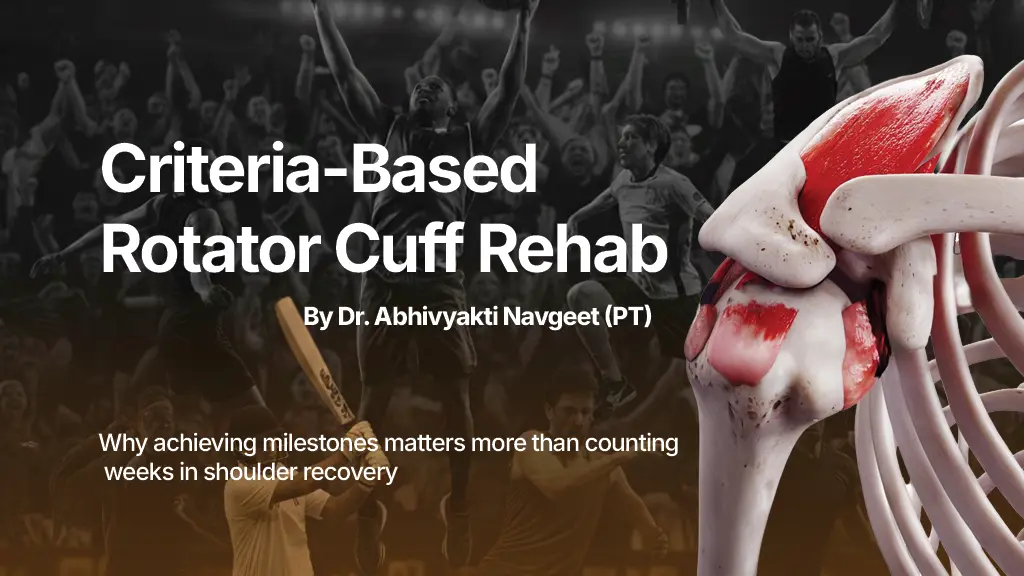
Criteria-based rotator cuff rehabilitation showing shoulder biomechanics, tendon loading, and clinical progression18Dec

Criteria-Based Rotator Cuff Rehabilitation: From Tissue Protection to Return to Sport

Rotator cuff rehabilitation has traditionally followed time-based protocols, progressing patients through predefined phases based on weeks post-injury or surgery. However, tendon healing and neuromuscular recovery do not respond to time alone—they respond to load. A criteria-based rehabilitation approach prioritizes measurable clinical milestones to guide progression safely and effectively, particularly in athletic and high-demand populations. This article outlines a phase-wise, criteria-driven framework for rotator cuff rehabilitation, as explained by Dr. Abhivyakti Navgeet (PT). Why a Criteria-Based Approach Matters The rotator cuff functions as a dynamic stabilizer, responsible for centering the humeral …
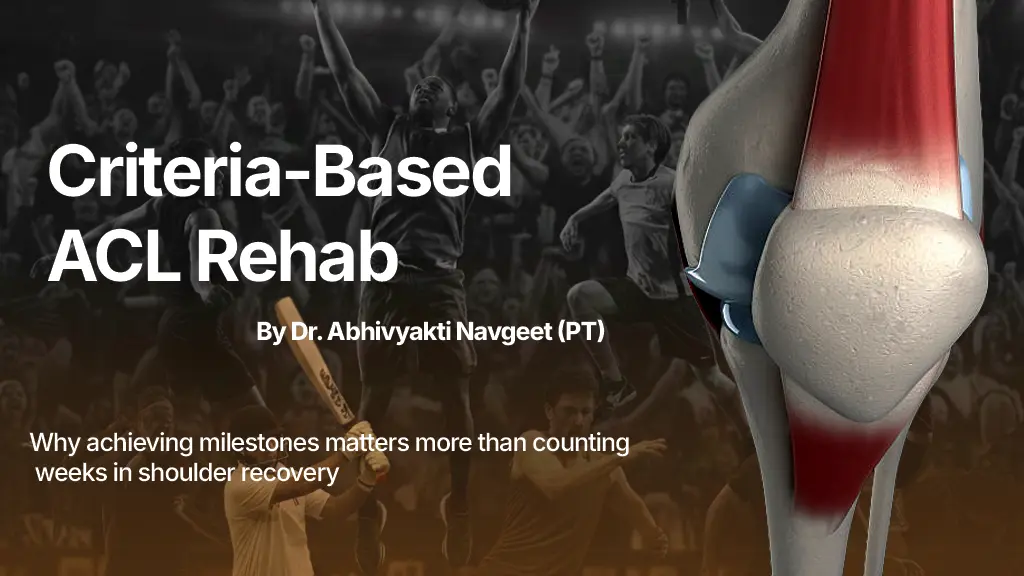
Criteria-based ACL rehabilitation showing knee biomechanics and ligament loading for return to play decision-making18Dec

Criteria-Based ACL Rehabilitation: Objective Progression and Return-to-Play Decisions in Athletes

Return-to-play (RTP) following anterior cruciate ligament (ACL) reconstruction remains one of the most critical decisions in sports rehabilitation. Traditional time-based protocols offer general guidance, but they do not account for individual variability in healing, neuromuscular control, or psychological readiness.   https://youtu.be/aqcqAxOpQEs   A criteria-based rehabilitation model emphasizes objective progression markers to guide clinical decision-making and reduce re-injury risk. Early Rehabilitation Priorities The initial phase of ACL rehabilitation focuses on restoring foundational joint function and controlling post-operative symptoms. Key clinical objectives include: Restoration of full knee extension Reduction of pain and …
14Dec

Game Over for Pain – The Healing Power of Video Games in Physical Therapy

  Video games have long been associated with mindless entertainment and the sedentary lifestyle, but what if we told you that video games can actually be a valuable tool in the process of rehabilitation? It may sound counterintuitive, but numerous studies have shown that video games can improve cognitive and physical function, enhance motor skills, and even help with pain management. Whether you’re recovering from an injury or dealing with a chronic illness, video games may just be the prescription you need to speed up your recovery and get back …
10Oct

How Research is Physiotherapy’s way forward

The scope of any form of development is determined by its quality of research. The same goes for physiotherapy but in this case, that same research is grossly lacking in substantive and quantity. We asked Dr. Mridul Makkar, an ex-physiotherapy associate and current research associate at Christian Medical College, Ludhiana of what she makes of the current scenario of research in physiotherapy.   Is the lack of physiotherapists in India a factor to the lack of evidence-based research too? While India lacks physios for sure, the problem isn’t just the …
26Sep

Understanding Patient Adherence From A Physio

  Perhaps the most important but frequently overseen factor in recovery success is patient adherence and emotional understanding. Having a clear insight into the headspace of both the patient and the physio would be key to improving patient-physio relations. Here’s what Dr. Pallavi Variyani, a PhD candidate in community health and rehabilitation to say about patient adherence.   Why is patient adherence important? Dr. Pallavi explains patient adherence the best way possible i.e., a doctor’s commitment to a patient. Be it making patients feel better and confident about themselves to …
20Sep

UNFORSEEN ALLIES? YOGA & PHYSIOTHERAPY

Maybe Indians have known this for a while. Maybe we don’t. But as modern healthcare takes a turn to make itself more efficient, we’ve also begun excavating our roots. And when one comes across yoga, maybe we can say, “In search of gold, we lost a diamond”. We went down that route with Dr. Neha Deo, a certified yoga practitioner and physiotherapist, who’s been around for more than a decade. She explained yoga for what it is and how physiotherapy is better because of it. Here’s what she had to …
13Sep

DECODING AI’S FUTURE IS ORTHOPEDIC CARE

With physiotherapy and orthopedic care entering an era of massive technological changes, understanding its implication is of vital importance. And who better to review it than an orthopedic himself! In this version of Ashva interviewing healthcare practitioners, we have Dr.Vijayesh Tighare, a young and enthusiastic orthopedic resident at Indiana medical college and hospital, Mangalore, who’s committed to helping people live healthier, both mentally and physically.   How does AI change the playing field for orthos? Having to deal with multiple patients in a single day is a huge strain for …
18Aug

AI-Integrated Physiotherapy: Affordable & Accessible Solutions.

When a person meets with an accident, the general perception is that the initial treatment is the biggest financial concern. People readily and even recklessly, spend in surgeries and primary medications, assuming that’s damage controlled. And this is exactly the moment where you can sigh and say, “Oh no” to the supposedly, unforeseen expenses – physiotherapy.   In an ideal world, you would want healthcare to be as affordable as possible. Unfortunately, that’s not India’s reality. With the approximate cost of each session ranging from Rs. 500 to Rs. 1500, …
17Aug

Transforming Gait Analysis: Fitknees – Redefining Accessibility and Comfort

Gait analysis, a crucial aspect of diagnosing musculoskeletal conditions, has long relied on traditional methods that come with certain inconveniences. However, a new solution:  Fitknees. has emerged that not only addresses these challenges but addresses comfort, portability, and local excellence . It redefines diagnostics for better healthcare , but also enhances the overall experience for patients and healthcare professionals alike. The Conventional Challenge: Comfort vs. Insight In the traditional gait analysis process, patients are required to undress and walk in a dimly lit room for an extended duration, typically around …
09Aug

Unlocking the Intricacies of Gait Analysis: A Comprehensive Guide.

Walking, running, or even a simple jog – they all stem from the complex choreography of our body’s limb movements. This intricate interplay, known as gait, is the cornerstone of our locomotion. It’s a phenomenon that can reflect natural patterns or arise from neuromuscular anomalies. Gait involves a synchronized bipedal movement, defying gravity through the ground reaction force. The Crucial Factors of Gait Formation: Hip Joint: It’s the remarkable ball-and-socket joint uniting the pelvic bone’s acetabular surface with the femur’s upper end. Knee Joint: This hinge joint connects the femur’s …
03Aug

“Advancing Physiotherapy: Unleashing the Power of Research”

The Importance of Research in Physiotherapy   Why research? In the ever-evolving realm of physiotherapy, where science meets human potential, the quest for knowledge takes centre stage. Imagine a world where every decision made by physiotherapists is grounded in scientific evidence, where treatment strategies are fine-tuned to maximize patient outcomes, and where cutting-edge innovations reshape the landscape of rehabilitation. This world exists within the realm of research, where the relentless pursuit of knowledge fuels progress and sets the stage for groundbreaking advancements.   Physiotherapy, as a discipline, constantly seeks to …
03Aug

Unlocking the Power of Data in Physiotherapy: How Fitknees Revolutionizes Patient Care and Research

The first and foremost thing one should know about science is that it is ever-growing and scientific knowledge will continue to grow as long as the human species exists. A scientific database is a computerized, organized collection of related data, which can be accessed for scientific inquiry and long-term stewardship. Physiotherapy is a science, and like all sciences, it should have a database.    Why is a database important?   When a therapist treats a patient, it is very essential that they know the rate of their progress. One of …