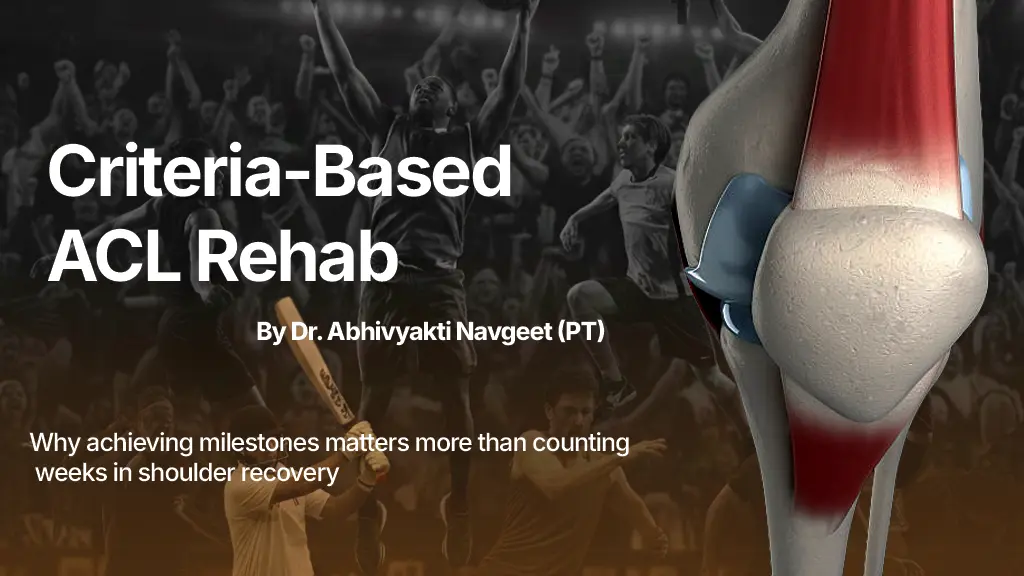
Return-to-play (RTP) following anterior cruciate ligament (ACL) reconstruction remains one of the most critical decisions in sports rehabilitation. Traditional time-based protocols offer general guidance, but they do not account for individual variability in healing, neuromuscular control, or psychological readiness.
A criteria-based rehabilitation model emphasizes objective progression markers to guide clinical decision-making and reduce re-injury risk.
Early Rehabilitation Priorities
The initial phase of ACL rehabilitation focuses on restoring foundational joint function and controlling post-operative symptoms.
Key clinical objectives include:
-
- Restoration of full knee extension
-
- Reduction of pain and effusion
-
- Early quadriceps activation
-
- Establishment of symmetrical weight-bearing patterns
Weight-bearing progression is influenced by surgical protocols and patient response. Current evidence supports early, controlled loading when tolerated, provided movement quality and symptom response remain appropriate.
Progression Criteria: Moving Beyond TimelineProgression between rehabilitation phases should be determined by measurable clinical criteria, not elapsed time alone.
Common early-phase progression markers include:
-
- Full extension with minimal swelling
-
- Knee flexion approaching ~120°
-
- Straight leg raise without lag
-
- Symmetrical gait without compensatory strategies
-
- Absence of dynamic valgus during functional tasks
These criteria establish readiness for increased loading and strengthening.
Objective Strength Assessment and Limb Symmetry
Quadriceps strength is a central determinant of functional recovery after ACL reconstruction. Objective strength assessment enables clinicians to quantify deficits and monitor progress across phases.
Handheld dynamometry provides reliable measurement of:
-
- Peak force output
-
- Limb Symmetry Index (LSI)
-
- Strength progression over time
Digital systems such as the Fitmust Digital Dynamometer allow repeatable testing, longitudinal tracking, and clear comparison between involved and uninvolved limbs. Progression to higher-demand phases is typically considered when quadriceps LSI exceeds ~70%, alongside acceptable movement quality.
Strength and Neuromuscular Control Phase
As strength improves, rehabilitation emphasis shifts toward:
-
- Closed-chain strengthening
-
- Functional squatting patterns
-
- Single-limb balance and proprioceptive training
-
- Hip and trunk control to reduce knee valgus moments
Interventions are progressed based on movement quality, load tolerance, and symptom response, rather than pre-defined timelines.
Running, Plyometrics, and Functional Testing
Preparation for running and sport-specific activities requires further objective confirmation of readiness.
Key indicators include:
-
- Quadriceps and hamstring strength symmetry approaching ~80% LSI
-
- Pain-free performance of single-limb tasks
-
- Controlled alignment during hopping and change-of-direction drills
-
- Resolution of post-exercise symptoms within 24 hours
Hop testing provides valuable insight into limb loading capacity and neuromuscular coordination during higher-velocity tasks.
Psychological Readiness and Confidence
Physical recovery alone does not determine successful RTP. Psychological readiness—including fear of re-injury and confidence under load—plays a significant role in outcomes.
Objective performance data supports psychological recovery by:
-
- Providing visible evidence of improvement
-
- Reinforcing readiness through measurable benchmarks
-
- Improving athlete trust in clinical decision-making
Regular feedback using objective metrics enhances both engagement and compliance.
Return-to-Play Criteria
Final RTP decisions should integrate multiple domains:
-
- Strength symmetry ≥95% LSI (via dynamometry)
-
- Hop test symmetry ≥95%
-
- Acceptable quadriceps-to-hamstring strength balance
-
- Absence of pain, swelling, or instability
-
- Clean movement patterns during sport-specific tasks
-
- Satisfactory psychological readiness measures
Meeting isolated criteria is insufficient; comprehensive readiness across domains is essential.
Clinical Implications
A criteria-based ACL rehabilitation framework:
-
- Reduces reliance on subjective assessment
-
- Improves communication with athletes and coaching staff
-
- Supports defensible RTP decisions
-
- Aligns with modern sports medicine standards
Objective measurement tools such as digital dynamometry play a critical role in enabling consistent, data-driven progression.
* Disclaimer
This protocol reflects the personal clinical framework and professional opinion of Dr. Abhivyakti Navgeet and is shared solely for educational purposes with webinar attendees.
This protocol has not been scientifically validated, peer-reviewed, or formally verified by Ashva Wearable Technologies Pvt. Ltd. Ashva Wearable Technologies Pvt. Ltd. does not claim, endorse, or promote this protocol as a standardized or approved clinical guideline.
The content is provided free of charge and may be shared at the discretion of the recipient. Any clinical application, interpretation, or modification of this protocol is the sole responsibility of the clinician using it. Ashva Wearable Technologies Pvt. Ltd. assumes no responsibility or liability for patient outcomes, clinical decisions, or misuse arising from the use of this material.
Clinicians are advised to apply independent clinical judgment, consider individual patient factors, and follow applicable professional standards, regulatory requirements, and evidence-based guidelines.